

Bad habits die hard.
No one knows that more intimately than someone like me, a true 20th-century child who’s lived through and burnt out on 20th-century comforts: cheap stimulants and cheaper illusions, the cigarettes that made us feel like rebel poets and rockstars when we were really just practicing a bizarre ritual of slow-motion mass-marketed self-immolation. Alcohol convinced us we were escaping something, when we were really just dissolving our brains in a lukewarm puddle of forgetfulness. Like all bad habits, they became the invisible machinery of our lives, support beams holding up the structure of our shabby routines, so that breaking them feels less like progress or liberation and more like an act of full-blown self-demolition.
Like our old personal bad habits died hard, the United States is a nation that’s been running on bad habits for decades now. Like a guy whose nervous system is thoroughly burnt out, so he pumps it full of stimulants to make it through the day. Whether an individual or nation, whenever one gets caught in this trap, eventually, it has to come to a very ugly end. Entropy always wins.
The U.S., like the guy strung out on stimulants, is long overdue for a cultural reset. Every other country in the world had one in the 20th century. Two world wars made sure of it. But the U.S. never did, and it glaringly shows. It’s why so many of us feel like something is unmistakably off that we can’t quite put our finger on, as if we’re living in a museum exhibit of American Greatness curated by people who’ve never once stepped outside, who keep insisting the animatronic diorama is real life, and who genuinely look confused—hurt, even—when the machinery begins to smoke, exposing the ruse. 1 And, I think the U.S. reset will really be a global reset and the whole world order is about to change. This came, as most great ideas do, from a random, historically-inaccurate meme about Poland on Facebook. Naturally.

A Meme About Poland, or How to Warp History
Last night, I spotted the offending meme, an image that made me think the Cold War was still going on. More accurately, it reminded me that the Cold War is over for everyone in the world—except the United States. 2 It wasn’t the politics of the meme that vexed me, but that it was factually incorrect in a politically convenient way. In other words, it’s accidental propaganda, and I’m bothered more by the misrepresented history than the political messaging.
It purported to show the horrors of the impoverished life under socialism in Poland in the early 1981. It was being pushed by a large historical account to millions of people that was wrong on the facts, not the politics. This wasn’t how most people lived throughout Poland’s 20th-century history, but an outlier, a case of martial law in 1981 due to political turbulence. 3
The meme’s cardinal sin is the bad reductionism of oversimplification.
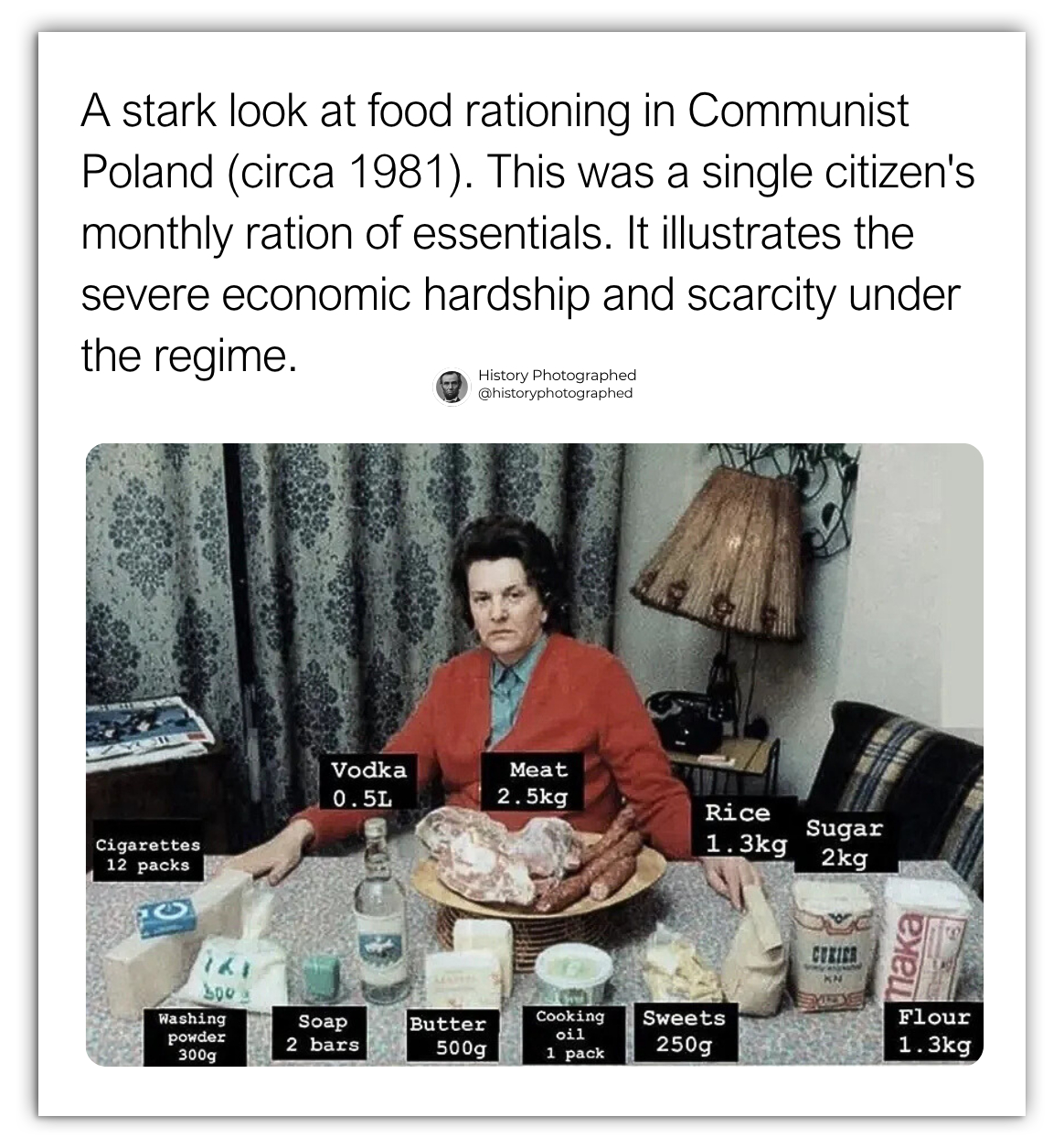
The whole thing was yet another regurgitated Cold War ghost story dressed up as internet history, because the real rationing of that kind in the socialist world happened during Stalin’s first five-year plan from 1928 to 1932, a short, brutal, economically disruptive experiment even the Russian Soviets dropped once they realized it was ruining their economic development. But try telling that to Americans raised on a diet of Cold War cartoons who still believe the USSR secretly survived inside a Matryoshka doll buried under every historical conversation about the period, or even the slightest criticism of capitalism (or imperialism). 4
The reality is, as usual, much more boring. Even the Stalin-era Soviets—hardly known for saying oops, my bad!—took one look at this failed policy and said, “Yes, well, never again.” But, today’s U.S. seems to believe that the entire history of every Eastern Bloc state was a history of rationing. 5 Our “bread and soup lines” pejoratives evince the embarrassing reality that we’ve simply not experienced what the rest of the world did in the 20th century and it shows. 6 Thus, the meme made clear that the historical world the U.S. is dwelling in, and the historical world the rest of the world is living in, are two completely different worlds.
A History of Major 20th-Century Resets
I’ve been reading a lot about the Eastern Bloc lately for obvious reasons. One, I just stepped foot in a still-living Socialist Republic for the very first time. The more important one is, my home country seems fast falling into something resembling totalitarian authoritarianism, and I want to know why.
One thing that’s become abundantly clear in my reading is that, for better or worse, the geopolitics of the 20th century forced pretty much everyone to endure a period of national redefinition, tremendous change that impacted everyone throughout their respective countries. “Resets,” I call them, a point where a nation has to redefine its national identity in order to survive. To understand that the U.S. never had its socio-political reset, it would help us to understand what a reset is. Again, history will be helpful. 7
Russia began its reset in 1905 when the tsarist order was challenged by a socialist revolution that upended millennia of hierarchy and attempted to build something radical from the ground up. This, of course, was brutally suppressed and would eventually turn into the 1917 revolution that turned into the other 1917 revolution that gave us Lenin, Trotsky, and eventually, Stalin who implemented the First Five-Year Plan which introduced rationing.
We’ve come full circle.
While much blood was shed, the Bolsheviks ripped down an empire that stood for centuries, replacing it with a revolutionary movement that reorganized everything from land ownership to literacy and the meaning of labor itself, challenging defectors just as ruthlessly as the tsarist regime before it had done. It wasn’t an election cycle or policy shift, it was a total transformation of the social organism of the country, a forced rebirth of a civilization that was still running on the fumes of centuries-old feudalism.
China underwent four resets. The first was the Century of Humiliation as China lived fractured under the ruling iron fist of British colonialism. Next up, Imperial Japan invaded and took swathes of the territory, raping women, destroying or seizing property, and generally causing havoc. Their British overlords seemed incapable or unwilling to help much. During and after WWII, there was the Chinese Communist revolution ending in 1949, which was a response to the Century of Humiliation, and then the Cultural Revolution of the 1960s, a self-inflicted political earthquake that tore apart its old, ossified systems, purged bureaucracies, attacked ideology, and re-educated itself in a frenzy of ideological purification that, for all its chaos and cruelty, left behind a fundamentally changed nation.
North Korea similarly experienced several resets, under Japanese occupation, another under Soviet liberation, another during the Korean War (which also caused South Korea to have a national reset), then another under Kim Il-Sung’s juche ideology, each compacting the new national identity tighter. 8
Vietnam reset itself through anticolonial war—first against Japan, then against Britain, then against France, then against the United States, then against Cambodia, then against China—years of struggle that torched the old colonial structures that had caused the country unimaginable loss and pain since the late-19th century. In related news, Vietnam gets the award for the most badass human beings on planet earth, and it’s not even close.
But it wasn’t just Eastern countries experiencing this. As Vietnam cast off the yoke of its French oppressors, France had to deal with its own redefining of society, especially after the humiliating defeat in WWII to the Germans. France might’ve been able to save face had it been able to save its colonies, especially the profitable colonies in Indochina (Vietnam, Laos, Cambodia), but the Vietnamese had other ideas and, when France lost handily at the Battle of Điện Biên Phủ, it was clear its days as a globe-spanning empire were over.
Britain underwent a reset more quietly but no less radically, shedding its global empire piece by piece throughout the 20th century, often willingly, like imperial death by a thousand tiny national self-amputations. Let’s not forget, Nazi Germany’s bombing of London made England start asking very sobering questions about whether their colonies were more important than the defense of their island. Hard to control half the globe when being bombed round-the-clock in The Blitz at home. Then they stumbled into Brexit, which looks suspiciously like post-acute imperial withdrawal syndrome.
Germany experienced an extremely violent reset on par with Vietnam. Defeat, occupation, denazification, division, reconstruction, reunification—each a complete redefinition of what it meant to be German, until the country that emerged in the late-20th century bore almost no resemblance to the one that marched into Poland in 1939. They offer us a reminder that your past must be confronted directly, not stuffed in a drawer.
Everyone reset, whole nations transformed, and all confronted the ugly specter of their own past, broke with it, and reentered the world as something new—everyone except the United States. 9
United States, Exceptionalism’s Wayward Children
The U.S. simply kept going, as if the fall of the Berlin Wall was the final scene in a monotone, late-night, YouTube history documentary and the credits would just roll on forever. We even wrote books about it. Fukuyama’s End of History wasn’t really a clever argument about liberal democracy, but an accidentally binding sentence condemning the U.S. to live in an inescapable 20th-century doomloop that would only get weirder and weirder as it refused to wake up from our surreal dream.
U.S. business leaders, politicians, and policymakers kept repeating Cold War gospels as if the war hadn’t ended and they’ve been doing it for so long, that it’s lasted all the way up until last night when I encountered the meme about Poland. They repeat their comforting slogans about free markets, global leadership, America Number One, typical unipolar world stuff, long after the world beneath their feet and to their outside had shifted. They still parrot the Cold War catechism today warning about radical leftists—in other words, still seeing Soviet shadows behind every minor discomfort or disagreement.
A very little-known fact about those Soviet shadows. The U.S.’ anti-Soviet position was so complete, that they long believed North Korea a Stalinist puppet state of the U.S.S.R., well after North Korea severed ties with both China and the U.S.S.R. and purged anyone loyal to Moscow in the 1950s. The result of this was the Pueblo Incident, where a U.S. warship, The USS Pueblo, was captured by North Korean forces in 1968. The U.S., still mistakenly believing North Korea had close ties with Moscow and China, asked the Soviets to step in and do something about it. They were shocked to learn the Soviets had zero control over North Korea and North Korea rejected overtures to return the ship and release the crew.
The North Koreans kept the ship. And in one of the most embarrassingly hilarious episodes in history that feels like the geopolitical version of a 2012 YouTube prank reel, in 1999, when the U.S. and South Korea performed joint military exercises in the Korean Peninsula, no doubt in an attempt to intimidate North Korea, North Korea in response towed the USS Pueblo from one side of the peninsula to the other to put it on public display, no doubt in an attempt to intimidate the U.S.-South Korean alliance.
The U.S. isn’t just getting high on its own supply of propaganda today. It has been since WWII. So what’s the problem? Well, reality, for starters.
You see, you can’t continually subject yourself to a fantastical version of reality, a rabbit hole that goes deeper and deeper and deeper without reality eventually confronting your fantasies. The fantasy is that we can force the future to fit into past models. But the future won’t contort itself around American nostalgia, it doesn’t care about our emotional comfort or bipartisan delusions, and the rise of Donald trump—no matter how any one of us feels about him—is stark proof that the U.S. desperately needs the coming reset.
Now, I can already sense some people thinking, “But what if Trump is the reset?” He’s not. He still abides the old oder. Cutting taxes for the wealthiest Americans while the poorest Americans literally go hungry is a much meaner Reaganomics cosplaying as Fascism, but it’s Reaganomics nonetheless. He still spews on about endless growth and deregulation and all the old-school Republican policies that have proved immensely destructive.
His rise isn’t a reset but the light in the car blinking to let everyone know the engine is about to fall out of the bottom before we all careen into a tree. His rise is a warning that the system—high on its own supply, remember—is no longer capable of producing functional leadership. Not even good leadership, but just leadership that passes. So it produced a reality-show host instead, a twisted cosmic joke at the expense of the modern West’s second-oldest democracy (Iceland was the first with their Alþingi, the Parliament of Iceland founded in 930 CE), but also a helluva red flag if I’ve ever seen one.
Trump is what happens when a group of people try to solve 21st-century problems with outdated 20th-century politics. He wasn’t a break with the 20th century but a fanatical reenactment of its ugliest moments: paranoia, strong-man imperialism, ethno-nationalism, still trying to defeat the Soviet Union decades after its collapse, like a boxer shadow-boxing an opponent who retired in 1991 to go get flabby in the suburbs. Does the United States’ weird, post-cold-war-paranoia swan-song not sound like sad reverberations from a 20th century empire who unknowingly sings about its soon-to-be-former greatness?
Does It Feel Like Everything’s Falling Apart, to You?
This lack of a Reset is why everything now feels unmistakably like it’s falling apart and the closer your country is to the U.S., the more it feels like it. Here in Asia, our quiet, flatulent rumbles barely move the needle on the Richter scale. But, in the U.S., almost everyone feels the squeeze and they’re crushed beneath the jaws of the vice grip. The country’s outward imperial ambitions now thwarted, the powerful are turning them inward on its own population, as tends to happen. 10
But, back in the U.S., our infrastructure crumbles while paralyzed leaders do nothing. Only countries who still believe in long-term investment can build infrastructure and the U.S. is still living in its 20th-century fantasy. Our healthcare has already disintegrated because the fantasy of pornographized political yesterdays hasn’t kept up with today’s high-paced reality. Our communication has failed because we can’t build a functioning network anymore that facilitates healthy, constructive conversations.
Our work lives deteriorate because our institutions are pretending it’s still 1958 and we all believe employee loyalty will be rewarded by the greediest corporations on earth, even though we all know it’s just a slow-motion mugging of everyone who isn’t pornographically rich.
Our cities fall apart because we can’t build anything without two decades of lawsuits, environmental impact studies, zoning tantrums, and a whole lot of loud screaming about NIMBYism. We never had our Reset. This is why the U.S. is still arguing about LGBTQIA+ policies and flirting with treating Black people like it’s 1952 again (or, for some, like it’s 1852 again) while the rest of the world moves along into the future.
In the U.S., we like to talk about the rise of China a lot as if there will just be one Superpower that rises up to challenge us and everyone else simply doesn’t matter. You see this in Trump’s cause-havoc-with-our-allies policies he’s recklessly employed. But the rest of the world has started moving on too.In short, the U.S. hasn’t redefined itself for a long time and it needs to tell the world a new story about what it is and what it’s all about if it wants to be understood as anything more serious than a caricature of a world left behind. It’s nervous system is collapsing, it’s been pumping stimulants for decades. But, eventually, our bad habits will catch up with us. 11 Turns out, you can’t live on hubristic, paranoid delusions of grandeur forever.
Which is why the Great American Reset is coming. It will be through the force of sheer historical necessity and inevitability. Everyone else globally has had to face theirs and history has been abundantly, extraordinarily patient with the United States, allowing every advantage to be taken, every fantasy indulged, and every opportunity to update itself voluntarily skipped. But the overdue 20th-century bill has finally come. What will that look like?
Are we ready for it?
Now, I know this is going to make some U.S. Americans uncomfortable, but in order to make the case, we’ll have to go through history without the propaganda.
No, this isn’t where it gets politically dogmatic; yes, we’re going to have to do what Americans find so uncomfortable (perhaps even impossible) to do these days, discuss politics with nuance. We’ll see.
In the early 1980s, Poland’s economy started having trouble through central planning missteps, isolation, and other causes before the political problems hit. The rise of the Solidarity trade union movement in 1980 had challenged the communist government, leading to strikes and work stoppages that disrupted production. In December 1981, General Wojciech Jaruzelski imposed martial law to crush Solidarity, which further destabilized the economy. Thus, the meme.
Unless you want to argue that Gen Z kids downing brainrot content online are the new USSR, and if that’s the case, yes, we are coming for you, one expressionless stare and quiet quit at a time.
In the sunset years of the USSR, the early 1990s, they did give out digital cards, the Soviet equivalent of SNAP benefits, but that’s not the same as society-wide, collective agriculture rationing seen in Stalin’s heyday of the 1920s and 1930s.
Besides, we had soup lines too in the 1930s, but that doesn’t flatter our ego as much as comparing ourselves to others in a favorable light like giving ourselves a high-five and demanding congratulations from every nation.
For the definitionally-uptight, let’s say that a Reset is a point where historical necessity forces a society to undergo inescapable society-wide change that encompasses the entire population and every institution.
Technically, the Allies liberated Korea. This is written as “Soviet liberation” because from the perspective of the North Koreans, it was the U.S.S.R. who first appeared on the scene to push back the Japanese, and it was the Soviets who liberated them, despite, in actuality, the defeat of Imperial Japan in the Pacific Theater was surely an allied operation that would’ve been near-impossible without the United States. The South Koreans didn’t experience the same “Soviet liberation” and thus the Korean War ensued.
Many other countries experienced the same. Pretty much the entirety of Europe, from Spain to Italy to the Balkans to Finno-Scandinavia.
What saddens me immensely is knowing that beneath this systemic collapse, like all other collapses and resets, lies immense human cost and pain. Burnout, despair, the quiet dread of waking up every morning and having to sell your labor to hustle up enough money to survive in a world that doesn’t even know itself and feels increasingly misaligned with itself. People aren’t failing to thrive in a healthy world but being forced to thrive in a society that no longer even knows what thriving means, that redefined thriving long ago.